AI technologies are advancing rapidly, transforming how we work, communicate, and innovate. But this progress also brings rising concerns about transparency, ethics, and safety. In response, countries worldwide are moving to regulate artificial intelligence though they are doing so in very different ways.
Navigating AI laws for global companies is quickly becoming a key business challenge. To stay competitive and compliant, AI developers and service providers must understand these evolving regulatory landscapes.
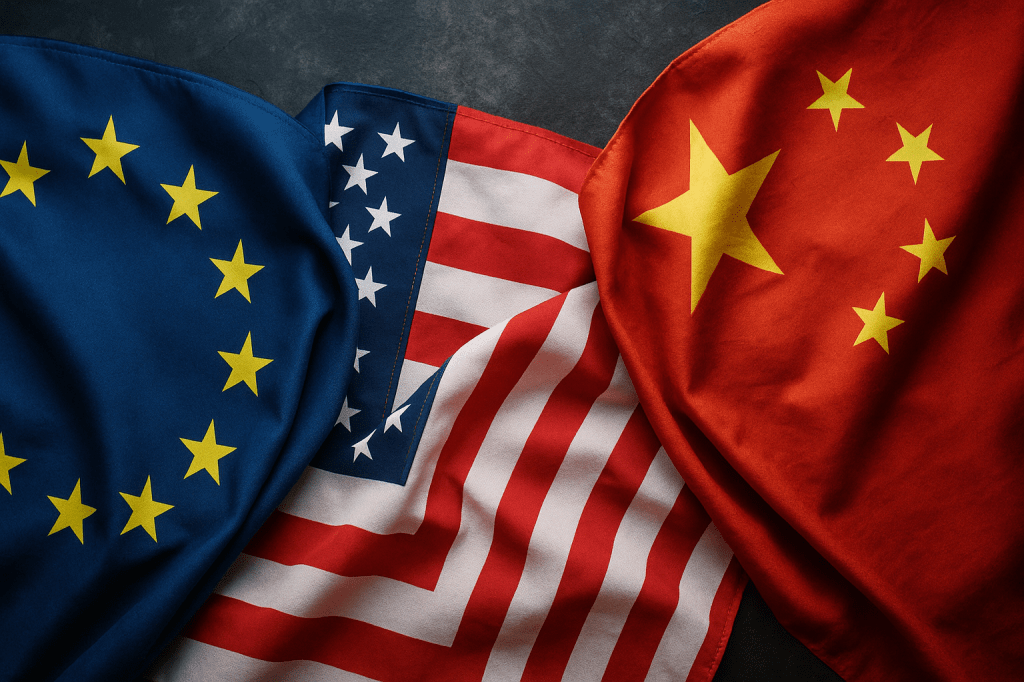
This post compares three of the world’s most influential AI governance frameworks: those of the European Union, the United States, and China.
Why AI Regulation Is Becoming a Global Business Challenge
Understanding the Diverging Paths of AI Laws
No two countries are regulating AI in exactly the same way. The European Union is pursuing strict risk-based legislation. The United States is relying on voluntary guidelines and sector-specific measures. China is taking a highly controlled and state-driven approach.
For companies operating across multiple markets, this divergence raises complex questions:
- How should AI models be trained, deployed, and monitored?
- What transparency and documentation are required?
- Are certain AI services restricted or prohibited entirely?
The Stakes for AI Companies Operating Internationally
Failing to comply with local regulations could lead to penalties, reputational damage, or product bans. Conversely, navigating these differences effectively can offer a competitive advantage and help companies build trust with regulators and customers alike.
The European Union’s Risk-Based Approach to AI Governance
What Is the EU AI Act?
The EU AI Act is the world’s first attempt to create a comprehensive legal framework specifically for artificial intelligence. Finalized in 2024, it sets global precedent for AI governance.
Risk Levels and Compliance Requirements Under the AI Act
The Act uses a risk-based framework, dividing AI systems into categories:
- Unacceptable risk: Certain AI uses, such as social scoring and manipulative behavior, are banned.
- High risk: AI used in sectors like healthcare, employment, law enforcement, and education must comply with strict safety, transparency, and data governance rules.
- Limited risk: Minimal transparency requirements, such as content labeling.
- Minimal risk: Freely permitted without added restrictions.
How EU AI Law Will Impact Global AI Deployment
Global AI companies seeking to enter European markets will need to ensure their products comply with these new obligations, especially in high-risk categories. Expect significant investment in compliance, documentation, and human oversight processes.
The United States’ Voluntary and Innovation-Driven AI Policy
Key Highlights of the White House Executive Order on AI
Rather than enacting sweeping legislation, the United States has so far leaned on voluntary and agency-driven measures. The most notable is President Biden’s Executive Order on Safe, Secure, and Trustworthy AI, issued in late 2023.
Key elements include:
- Developing AI safety standards through NIST.
- Requiring risk assessments for AI used in critical infrastructure.
- Encouraging watermarking of AI-generated content.
- Promoting voluntary industry commitments on safety and transparency.
Sector-Specific Guidance and Federal Agency Actions
Various US agencies are issuing their own AI-related guidance, creating a decentralized regulatory landscape. For example, the FDA is considering AI oversight in healthcare, while the FTC is addressing AI transparency in consumer products.
The Future of US AI Legislation
While there is growing bipartisan interest in federal AI legislation, no comprehensive bill has passed Congress yet. For now, the US remains industry-driven and innovation-friendly, with an evolving patchwork of guidelines.
China’s Strict AI Control and Licensing Requirements
Generative AI Security and Compliance in China
China’s AI governance focuses on state control and national security. Since 2022, regulators have issued rules covering:
- Algorithmic recommendation systems
- Deep synthesis (deepfake) technologies
- Generative AI services, effective as of mid-2024
The Role of State Oversight in AI Deployment
China requires pre-deployment security reviews for public AI services, licensing of AI providers, and strict content labeling. Data localization and censorship of politically sensitive content are also enforced.
Legal and Operational Challenges for AI Companies in China
Global AI companies face major hurdles in the Chinese market, including:
- Upfront government approval for AI models.
- Heavy restrictions on training data sources.
- Ongoing government monitoring of AI products.
Operating in China will likely require local partnerships, extensive compliance work, and market-specific AI models.
What Global AI Companies Should Do to Stay Compliant
Adapting to a Fragmented AI Regulatory Landscape
The current global regulatory environment for AI is highly fragmented. One-size-fits-all AI services are no longer feasible. Companies must:
- Monitor regulatory developments continuously.
- Build modular AI systems that can be tailored to local laws.
- Invest in transparent documentation and explainability features.
Building a Multi-Market AI Compliance Strategy
Successful companies will create multi-market compliance roadmaps covering:
- Data governance
- Model training and transparency
- AI-generated content labeling
- User rights and opt-outs
- Human oversight mechanisms
Turning Compliance Into Competitive Advantage
Proactively aligning with the world’s most stringent AI standards, such as those in the EU, can provide a trust premium in the global market. Companies that master compliance can position themselves as responsible and reliable AI leaders.
Final Thoughts: Preparing for the Next Phase of AI Regulation
The global AI regulatory landscape is still in flux, but the direction of travel is clear. Governments will demand more transparency, accountability, and safeguards. Companies that treat compliance as a strategic priority will be best positioned to thrive.
For AI innovators, navigating this complex regulatory map is not just a legal necessity, it is also an opportunity to build better, more trustworthy AI systems for the world.






 AI Everything Today
Leave a comment