Quick overview: what happened and who is involved
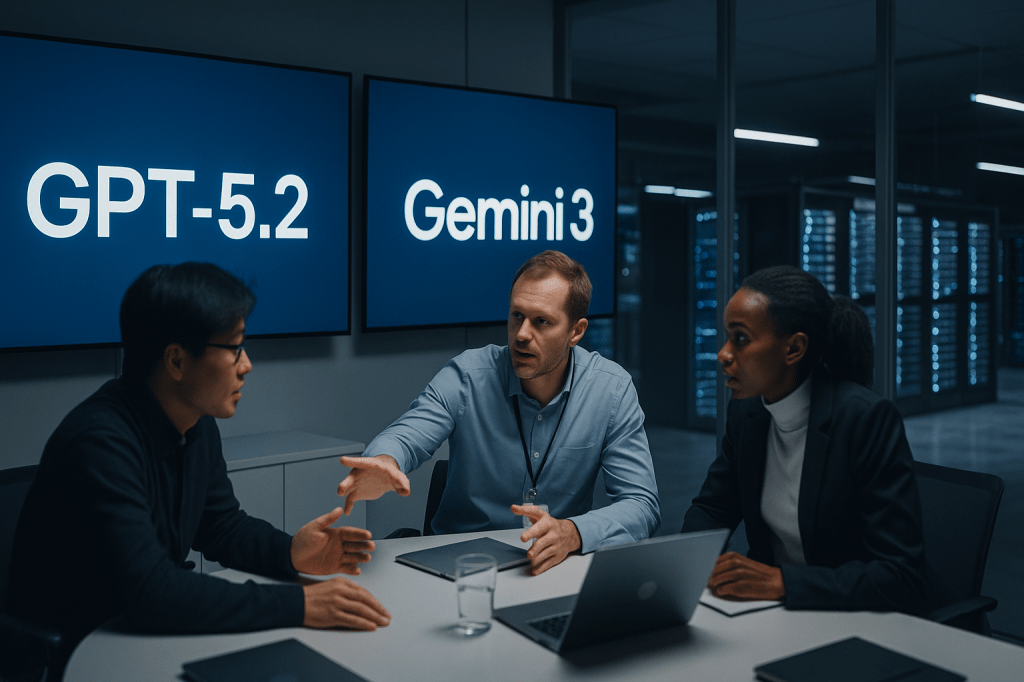
OpenAI and Google are in a high stakes competition in AI. Sources report that OpenAI CEO Sam Altman declared a “code red” after Google released Gemini 3, and that OpenAI is preparing GPT-5.2 as a rapid response. The new model is said to be ready and could be released as soon as next week. The update is aimed at closing performance and capability gaps introduced by Gemini 3.
This article explains what “code red” means inside a company like OpenAI, what GPT-5.2 is expected to change, and what these developments mean for everyday users, developers, and businesses. Key actors in this story are OpenAI, Sam Altman, Google, and the Gemini 3 model.
What does “code red” mean at OpenAI?
“Code red” is an internal phrase that signals urgent attention and priority. In this context it means OpenAI shifted resources and accelerated work after Gemini 3’s strong reception and leaderboard results. The aim is to close gaps quickly, not to pause other long term projects.
How companies use urgent responses
- Immediate triage and prioritization of engineers and researchers.
- Fast testing cycles and rapid iteration of model weights and prompts.
- Coordination across product, API, and safety teams to roll out updates.
Release timing and expectations for GPT-5.2
Sources say GPT-5.2 is ready and could ship as soon as next week. That timetable suggests a focused effort to deliver measurable improvements quickly. OpenAI may release GPT-5.2 to different audiences in stages, for example internal testing, select partners, then broader availability.
What to expect around launch
- Announcements or changelogs explaining new capabilities.
- Gradual rollout across ChatGPT tiers, APIs, and partner products.
- Potential tweaks to pricing or feature tiers depending on performance and demand.
Technical and product goals for GPT-5.2
The reported focus for GPT-5.2 is to close gaps with Gemini 3 in areas such as accuracy, multimodal understanding, tool use, code generation, and reasoning. The update is described as a rapid response rather than a full architecture overhaul.
Likely areas of improvement
- Accuracy and factuality, to reduce incorrect or misleading outputs.
- Multimodal capabilities, to better handle images and other input types alongside text.
- Tool use and plugins, to connect more reliably to external systems and APIs.
- Programming and reasoning performance, to produce cleaner code and stronger step by step logic.
How this changes the competitive landscape
OpenAI and Google are both pushing to lead the generative AI market. Anthropic and other companies also compete on model quality and safety. A rapid update from OpenAI could shift perceptions among developers, enterprise buyers, and researchers.
Short term effects
- Benchmarks and leaderboard rankings may change, affecting media coverage and customer interest.
- Developers may re-evaluate which model to integrate based on performance and cost.
- Enterprises might pause or accelerate procurement depending on new capabilities and stability.
Longer term implications
- Faster iteration cycles could raise user expectations for frequent improvements.
- Competition may focus more on practical integration features, not just raw benchmark scores.
- Companies will keep balancing speed of releases with safety and reliability work.
User experience and commercial effects
For everyday users, GPT-5.2 could mean better answers, smoother image understanding, and improved coding help in ChatGPT and other OpenAI products. For businesses, the API may offer enhanced capabilities that change internal tools, chatbots, or document automation.
Possible changes to expect
- Improved responses in consumer chat apps, with fewer errors and clearer reasoning.
- Enhanced multimodal features, for example better image captioning or visual question answering.
- API updates for developers, requiring some code updates or offering new endpoints.
- Potential changes to pricing or tier structure depending on compute costs and demand.
Risks and governance as models accelerate
Speeding up releases brings benefits and risks. OpenAI has safety teams and moderation systems, but rapid rollouts can increase the chance of unexpected behavior, hallucinations, or misuse. Regulatory and legal questions also matter as models become more capable.
Key governance considerations
- Hallucination mitigation, to reduce false statements or fabricated references.
- Content moderation and filtering, to prevent abusive or illegal outputs.
- Transparency and documentation, so users and integrators know model limits and training scope.
- Compliance with regulations in different countries, for enterprise and consumer use.
What developers and businesses should watch for
If you build on OpenAI products, watch for API announcements, changelogs, and migration guides. Test new behavior in staging environments before deploying to users. Keep an eye on latency, per token costs, and any new rate limits or quotas.
Practical steps
- Plan for staged testing, with automated checks for hallucinations and regressions.
- Review billing and quota changes to estimate costs if usage grows after an update.
- Update integrations that rely on specific model outputs, prompts, or plugin behaviors.
Story angles and what to watch in the next week
Reporters and analysts will likely focus on three themes if GPT-5.2 ships quickly. First, comparative benchmarks against Gemini 3. Second, product changes in ChatGPT and API features. Third, any signals about how OpenAI manages safety during a fast rollout.
Items to watch
- Official release notes from OpenAI detailing capability and safety changes.
- Benchmark results and hands on tests from independent researchers and developers.
- Signals from enterprise customers about adoption or pauses in procurement.
Key takeaways
- OpenAI declared an internal “code red” after Google released Gemini 3, according to sources.
- GPT-5.2 is reported to be ready and could be released as soon as next week, aimed at closing capability gaps.
- The update focuses on accuracy, multimodal skills, tool use, and coding and reasoning improvements.
- Faster releases change the competitive dynamic, and they increase pressure on safety and governance work.
FAQ
Is GPT-5.2 confirmed by OpenAI?
At the time of reporting, sources say GPT-5.2 is ready and could be released next week. Official confirmation and release notes would come from OpenAI.
Will this change my ChatGPT experience?
Possibly. If OpenAI rolls out GPT-5.2 widely, users may see improved answers, better image handling, and stronger code assistance. Changes will likely arrive in stages across tiers and APIs.
Should developers switch models right away?
Not automatically. Developers should test GPT-5.2 in staging, check for differences in outputs and latency, and plan rollouts carefully. Evaluate costs and integration changes before switching production traffic.
Conclusion
The reported “code red” at OpenAI and the potential near term release of GPT-5.2 show how quickly the top AI companies are iterating. If GPT-5.2 arrives next week as sources say, it may shift technical rankings and user expectations. The change could bring better performance for many tasks, but it also increases the need for careful testing and safety oversight. For users, developers, and businesses, the next few days may bring important announcements and an opportunity to evaluate what the next generation of models can actually do in real world settings.




 AI Everything Today
Leave a comment