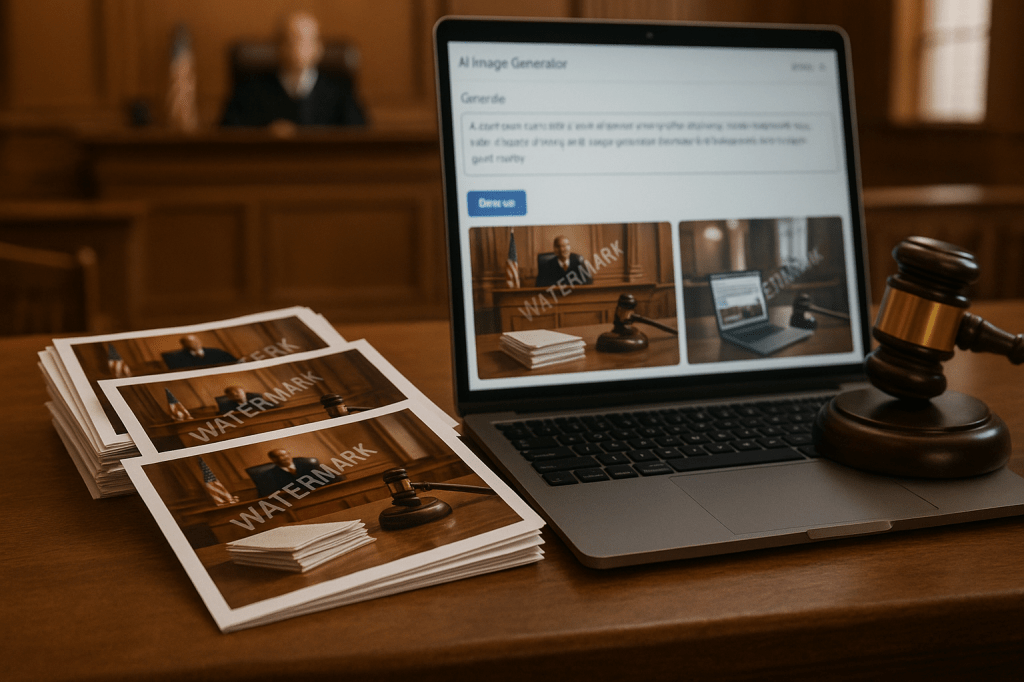
Quick overview: Getty Images, Stability AI, and the UK High Court ruling
England’s High Court issued a mixed ruling in Getty Images versus Stability AI. The judge found that Stability AI infringed Getty trademarks when the Stable Diffusion model reproduced Getty watermarks in generated images. At the same time, the court rejected key copyright infringement claims after Getty withdrew its central allegation about how the model was trained. That withdrawal limited the decision’s value as a precedent on whether AI systems must obtain permission to train on copyrighted works.
This outcome matters for photographers, artists, AI makers, and the public. It leaves open major legal questions about training data, model behavior, and how output that echoes existing works should be treated under copyright law. Cases in the United States, and recent industry settlements with AI companies, are filling parts of the gap while policymakers consider clearer rules.
What the court actually decided
Here are the core points from the High Court judgment.
- The judge found trademark infringement. The court agreed that Stable Diffusion sometimes reproduced images that included Getty watermarks, and that reproduced watermarks could mislead users about source and association.
- Key copyright claims were dismissed. Getty had raised claims about secondary copyright infringement, including that the model had been trained on Getty images without permission. Getty withdrew its central training claim during the trial, citing weak evidence, and the court did not find that Stable Diffusion stored or reproduced Getty’s copyrighted works in a way that breached copyright.
- Legal reasoning was narrow. The court focused on whether the model physically stored or directly reproduced copyrighted material. It concluded that the model generates images from learned patterns rather than copying files, meaning the decision avoided a clear rule about lawful or unlawful training on copyrighted content.
Why Getty withdrew a key charge, and why that matters
Getty dropped its main allegation about developers using Getty images to train Stable Diffusion partway through the trial. Getty explained the evidence supporting that claim was not strong enough. That step mattered because without a full determination on training, the High Court could not set a general rule about whether training on copyrighted material requires permission.
In practical terms, the judgment leaves a gap. The court rejected some copyright claims, but it did not resolve the bigger question facing the industry. Courts in other countries, and legislatures, may reach different conclusions unless there is clearer legal guidance.
What the court said about models, storage, and reproduction
The judge made a distinction between a model that stores or outputs copyrighted files and a model that generates new content from learned patterns. For the court, that distinction was crucial. The finding was that Stable Diffusion did not store Getty’s image files in a way that would amount to literal reproduction of those files.
For readers who are not lawyers, here is a short definition. Training means using many examples to let a machine learning model learn patterns. Reproduction means outputting the same or substantially the same thing as an existing protected work. The court treated pattern learning differently from literal copying, which is why the ruling avoided a sweeping statement about training.
How the decision fits with US litigation and recent settlements
The UK ruling arrives while related cases continue in the United States. Getty has refiled some claims in US courts. At the same time, the industry has seen settlements and licensing deals between AI companies and rights holders, for example settlements involving a major music company and an AI firm, and licensing agreements with other creators. Those agreements are shaping commercial practice while courts and policymakers work through legal standards.
Practical implications for AI developers
For developers and companies building models, the ruling sends several signals, without giving final answers.
- Watermarks matter. Reproducing watermarks can trigger trademark and branding issues, so model developers should test and reduce outputs that copy visible watermarks.
- Training data practices remain risky. Because courts have not settled whether training on copyrighted works without permission is lawful in all cases, companies should assess legal risk and consider licensing where possible.
- Technical mitigations can help. Options include filtering or excluding certain sources, developing watermark removal protections, and adding guardrails to reduce replication of training examples.
- Documentation helps with compliance. Keeping clear records of training data, sources, and consent can improve legal and regulatory positioning if disputes arise.
Impact on creators, photographers, and stock agencies
Creators and agencies that own large photo collections face several choices.
- Negotiate licensing deals. Some agencies may seek licensing arrangements with AI firms to get paid for use of their photos in training and commercial systems.
- Push for takedown or control tools. Rights holders may pursue technical and legal mechanisms to prevent unauthorized copying or to detect outputs that mimic their works.
- Advocate for clearer law. Many creators want legislators to set clearer rules about permissible training and about how outputs that resemble a source work should be treated.
Policy questions and what lawmakers can do
This case shows why policy matters. Courts will take time to resolve questions across jurisdictions. Legislators and regulators can reduce uncertainty by clarifying two issues, at minimum.
- Training transparency and permissions. Should AI developers be required to get permission, or pay for, copyrighted works used for training? Clarifying this would affect how models are built and funded.
- Use of model outputs. When a generated image resembles a copyrighted photo, should that be treated as infringement, or is it a new work? Rules here will guide creators and consumers about what is allowed and what is not.
What to watch next
Key developments to follow in the coming months.
- Ongoing US litigation. Getty and other parties are pursuing claims in US courts, which may produce different results.
- Industry settlements. Expect more licensing deals between AI firms and content owners as a fast route to reduce legal risk.
- Regulatory action. Lawmakers in multiple countries are examining whether new rules are needed to govern training and output use.
Key takeaways
- The High Court found trademark infringement where an AI model reproduced Getty watermarks.
- The court rejected the main copyright claims after Getty withdrew a central training allegation, so the decision does not set a clear precedent on training AI with copyrighted works.
- Developers should manage risks through data practices, output filtering, and documentation. Creators may pursue licensing, detection tools, or policy advocacy.
- Expect more legal and commercial developments in the United States and through private agreements that will shape practical outcomes.
FAQ
Did the court say training on copyrighted works is legal?
No. The court did not make a general ruling that training on copyrighted works is lawful. Getty withdrew its central training claim and the judge focused on whether the model stored or reproduced copyrighted files.
Can AI companies still face copyright suits?
Yes. Legal risk remains. Other cases in different courts may reach different conclusions, and rights holders can pursue claims based on how models were trained or how outputs match existing works.
What should creators do now?
Creators should track how their work is used, consider licensing discussions with AI firms if they want compensation, and use available detection methods to spot problematic outputs.
Conclusion
The High Court decision in Getty v Stability AI provides some clarity on watermark and trademark issues, but it leaves a major question unresolved, whether training models on copyrighted material requires permission. For now, the ruling changes parts of the conversation but does not deliver a final rule. Expect additional court cases, commercial agreements, and possible regulatory steps to fill the legal vacuum. Those developments will shape how AI tools are built, how creators get paid, and what consumers can expect from generative systems.


 AI Everything Today
Leave a comment