Quick overview: who, what, and why it matters
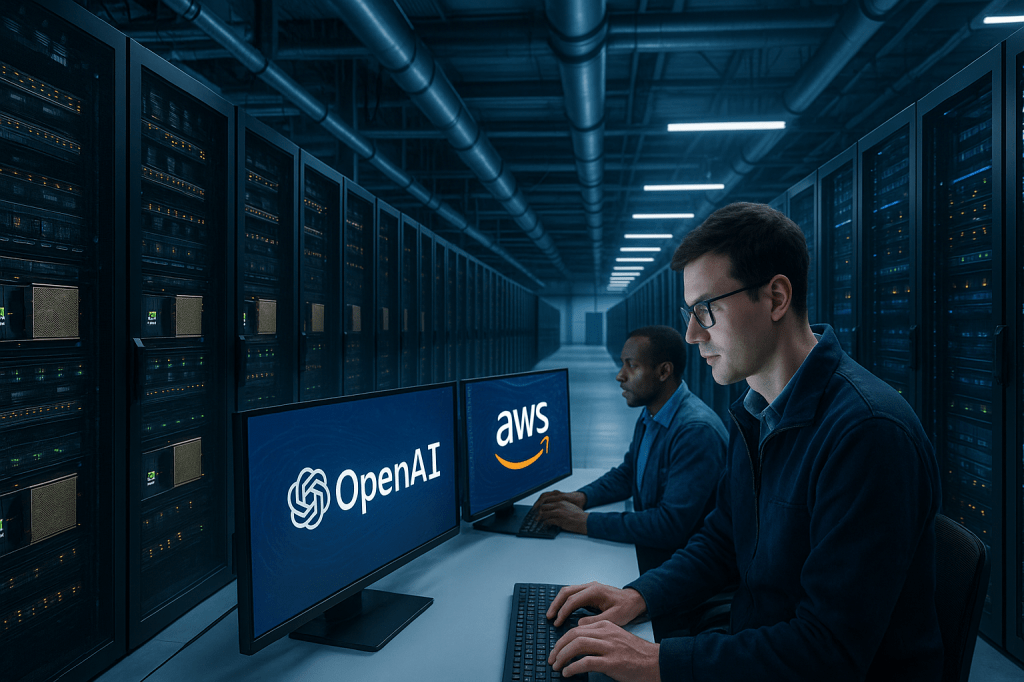
OpenAI has signed a seven-year agreement with Amazon Web Services, worth about 38 billion US dollars, to access hundreds of thousands of Nvidia GPUs for training large AI models. The companies say capacity will be deployed before the end of 2026, with room to expand into 2027, and OpenAI will begin using AWS compute immediately.
This deal sits alongside OpenAI commitments to other cloud providers, including Microsoft Azure and Oracle, and it reshapes where OpenAI runs its compute. Key names to remember are OpenAI, Amazon Web Services, Nvidia, Microsoft, and Oracle.
What the agreement covers
The public details of the arrangement include these core points.
- Length and value, a seven year contract worth about 38 billion US dollars.
- Hardware, access to what the companies describe as hundreds of thousands of Nvidia GPUs optimized for AI model training.
- Timing, capacity planned for deployment before the end of 2026 with capacity flexibility into 2027, and immediate access for some workloads.
- Strategy, OpenAI keeps sizeable commitments to Microsoft and Oracle while adding AWS as a major compute partner.
Why this matters to everyday readers
Most people will not buy GPUs or run model training at scale, but this deal matters because it affects the cost and speed of AI development, the services companies will offer, and the market for cloud computing.
- Faster models. More GPU capacity can speed up the pace of model training, which can change how quickly new AI features or improvements reach consumer apps and tools.
- Service pricing. Large, long term contracts can shape pricing decisions by cloud providers, which eventually influence costs for smaller businesses and consumers.
- Industry concentration. The deal highlights who controls major AI infrastructure, which affects competition, supply chains, and access for startups.
How this shifts cloud competition
AWS gains a major anchor client in OpenAI, which strengthens Amazon’s position among hyperscale cloud providers. Microsoft remains a major partner for OpenAI, but the addition of AWS signals that OpenAI is diversifying where it runs compute.
That matters because cloud competitors may respond in these ways.
- Pricing and deals, other providers might offer their own incentives to retain or win customers who need large GPU fleets.
- Capacity planning, cloud companies will need to adjust their procurement and datacenter buildouts to secure and deploy GPUs at scale.
- Vendor lock in, customers will evaluate whether tying work to a single provider is risky, and large buyers like OpenAI can push the industry toward multi cloud arrangements.
Nvidia GPU supply and logistics
GPUs for AI are specialized accelerators that are in high demand. Securing hundreds of thousands of them intensifies competition for a limited supply of top tier accelerators from Nvidia.
Operational questions include these items.
- Manufacturing and delivery timelines, building and shipping GPUs at this scale requires coordination with Nvidia and its suppliers.
- Data center buildouts, racks, power, and cooling must be provisioned to host dense GPU clusters.
- Networking and software, high performance interconnects and orchestration software are required to run large training jobs efficiently.
Technical and operational challenges
Installing and running massive GPU clusters is not as simple as placing hardware in a room. There are complex infrastructure needs and reliability concerns.
- Power and cooling, GPUs consume a great deal of electricity and require advanced cooling systems to operate reliably.
- Physical space, datacenter capacity must be available and configured for dense GPU deployment.
- Networking, distributed training depends on very fast network links and low latency between GPUs.
- Software and tooling, efficient scaling needs specialized software, workload schedulers, and monitoring systems.
Business and financial context
The 38 billion dollar AWS deal sits beside other large commitments OpenAI has made or reported. Those commitments include much larger figures attributed to Microsoft and Oracle for cloud capacity and services. Taken together, these agreements show how AI model development is shaping multiyear partnerships between AI firms and cloud providers.
Key business implications are as follows.
- Risk sharing, long term contracts spread costs and risk between cloud provider and customer.
- Strategic positioning, cloud companies gain important customers that help them define their market offerings and attract other AI workloads.
- Financial commitments, the sheer size of these deals affects company valuations and investment decisions in datacenter capacity and chips.
Regulatory and antitrust considerations
A deal of this size raises questions about competition and national security review in some jurisdictions. Governments and regulators are increasingly attentive to concentration in AI compute and to which companies control critical hardware and data.
- Competition, regulators may examine whether very large contracts reduce competition in cloud or chip markets.
- Export and security, advanced AI hardware and models can raise export control or national security questions, especially across borders.
- Transparency, regulators may ask for clearer reporting on which providers host key model training and the safeguards in place.
Effects on startups and enterprise customers
Startups and enterprises watch large deals because they influence availability and price of compute. A few likely outcomes are listed below.
- Access pressure, more capacity tied up in long term deals can make it harder for smaller players to obtain high end GPUs at short notice.
- Partner opportunities, smaller companies may form partnerships with cloud providers to gain a path to capacity or discounted pricing.
- Market segmentation, cloud providers may offer tiered access and new services tailored to AI development needs.
Narrative and trust implications for OpenAI
By diversifying compute partners, OpenAI reduces the risk of being overly dependent on a single cloud provider. That can influence how independent the company appears when making product or research choices.
Signals to watch include these items.
- Operational independence, running models across providers can reduce single points of failure.
- Product timing, access to more GPUs may speed model releases or feature updates.
- Governance, large infrastructure deals can shape internal decision making about investments and partnerships.
Short term and long term effects
Short term, expect more capacity going to OpenAI training jobs and pressure on Nvidia supply. Longer term, the deal could influence cloud pricing dynamics, datacenter investment, and competitive strategies across major providers.
Key takeaways
- OpenAI and AWS signed a seven year, 38 billion dollar deal for hundreds of thousands of Nvidia GPUs, with capacity planned before the end of 2026.
- The agreement strengthens AWS as a major AI infrastructure provider, while OpenAI keeps large commitments to Microsoft and Oracle.
- The deal affects GPU supply, cloud competition, startup access to compute, and may attract regulatory attention on competition and security issues.
FAQ
Will this make AI cheaper for consumers?
Not directly. Large contracts can help cloud providers plan capacity and pricing, but consumer prices depend on many factors including competition, energy costs, and how companies choose to price services.
Does this mean OpenAI is leaving Microsoft?
No. OpenAI continues to work with Microsoft and Oracle while adding AWS as another major compute partner. The move is about diversification rather than replacement.
Could this reduce access for smaller AI startups?
There is a risk that long term reservations of high end GPUs could tighten short term availability. Cloud providers often respond by creating programs for startups, but availability and pricing can be affected while supply is constrained.
Will regulators intervene?
Large infrastructure contracts can attract regulatory interest, especially if they shift market power. Any intervention would depend on jurisdictional rules and the specific competitive effects regulators identify.
Conclusion
The seven year, 38 billion dollar GPU agreement between OpenAI and AWS is a major milestone in how AI models are trained and where critical compute resources are allocated. It strengthens AWS as a provider for AI workloads, it intensifies demand for Nvidia GPUs, and it highlights how cloud partnerships shape the pace and direction of AI development.
For everyday readers, the most visible effects may be faster updates in AI tools, evolving pricing for cloud services, and a market where a few large providers play an outsized role in enabling new AI features and products.






 AI Everything Today
Leave a comment