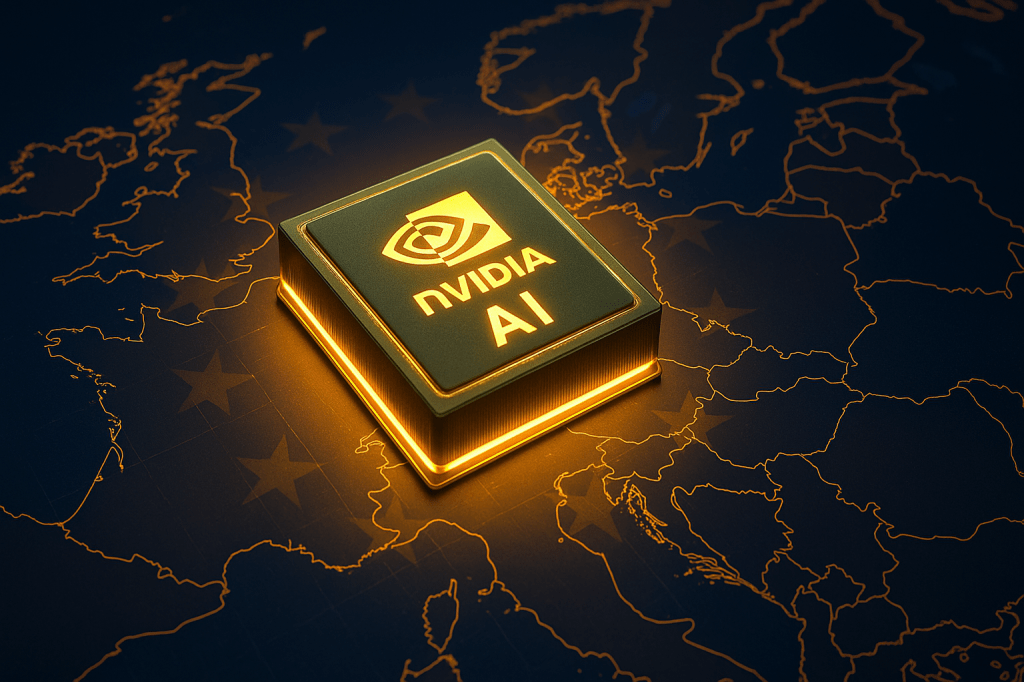
What Is Sovereign AI?
“Sovereign AI” is a term popularized by Nvidia CEO Jensen Huang. It refers to a country’s ability to build and control its own AI infrastructure, data, and models rather than relying on foreign platforms or cloud providers. It’s a concept that speaks directly to Europe’s long-standing concerns about digital dependency on U.S. and Chinese tech giants.
For Europe, sovereign AI isn’t just a technological issue. It’s a question of cultural identity, legal sovereignty, and economic resilience.
Why Europe Is Embracing This Idea
Over the past few months, Nvidia’s top executives, including Huang, have been on a European tour promoting this vision. The message: Europe needs to be a maker, not just a consumer, of AI.
Here’s how key countries are responding:
- United Kingdom: The UK pledged over $13 billion toward building AI supercomputing infrastructure.
- France: President Emmanuel Macron called AI “a sovereignty battle” and backed Mistral AI in launching a 18,000-GPU AI factory near Paris.
- Germany: Leaders are emphasizing the role of AI in securing digital and economic independence for the nation.
The broader EU is aligning its policy, investment, and partnerships toward developing an AI ecosystem that reflects European values including privacy, transparency, and linguistic diversity.
Infrastructure in Action: The AI Factories Are Coming
Mistral AI and Nvidia’s Mega Data Center
French startup Mistral AI, in partnership with Nvidia and Scaleway, is building one of the largest AI data centers in Europe. It will house 18,000 of Nvidia’s Grace Blackwell GPUs, enabling the training of open-weight large language models tailored for Europe.
EU-Wide AI Giga-Factories
The European Union plans to launch at least four AI mega-hubs over the next few years, investing billions to ensure it has the compute power to keep pace with global innovation.
Telecom and Public Media Partnerships
Telecom leaders like Orange and Swisscom, along with the European Broadcasting Union (EBU), are working with Nvidia to launch localized sovereign AI cloud services that follow EU laws and support regional languages and cultures.
Opportunities and Challenges
Benefits for Europe
- Cultural alignment: European AI systems can respect local languages, histories, and social norms.
- Policy control: Infrastructure within EU borders supports compliance with GDPR and other regulations.
- Economic boost: Sovereign AI investments fuel job creation and innovation across startups and universities.
The Hurdles Ahead
- Energy costs: AI data centers are energy-intensive, and power usage could reach 3% of the EU grid by 2030.
- Funding gap: U.S. tech companies often outspend European initiatives by tens of billions.
- Talent shortage: The EU still lags in attracting and retaining AI engineers and data scientists.
Nvidia’s Role: Partner or Gatekeeper?
While Nvidia is enabling Europe’s AI growth, it remains the primary supplier of GPUs and foundational software giving it significant influence over the emerging AI landscape. Critics argue that while Nvidia supports sovereignty in theory, it still profits from maintaining global reliance on its hardware and AI stacks.
That said, Nvidia’s investments are welcomed. Its partnerships across Europe signal a shift from passive dependence to active ecosystem-building.
The Broader Vision: Europe’s AI Independence
The idea of sovereign AI has quickly gone from buzzword to policy reality. The EU is:
- Creating alternatives to U.S. cloud platforms like AWS and Azure.
- Funding independent AI model developers such as Mistral, Aleph Alpha, and others.
- Building pan-European educational programs to train the next generation of AI experts.
- Pushing for regulation-first AI development, prioritizing safety and human rights.
All of this is designed to reduce vulnerability, build trust, and ensure that AI tools reflect Europe’s democratic values.
Conclusion: Not Just Catching Up, Leading with Values
Nvidia’s Sovereign AI campaign has catalyzed something much larger in Europe, a realignment of priorities around digital self-determination. While technical challenges and funding gaps remain, the momentum is unmistakable.
Europe is no longer content to be a client of AI technology made elsewhere. It wants to shape the future of AI on its own terms and thanks to partnerships with companies like Nvidia, it now has the tools to do it.
Key Takeaways
- Sovereign AI is about national control over AI infrastructure, data, and innovation.
- Nvidia is enabling Europe’s AI development through GPU supply and partnerships.
- Countries like France, Germany, and the UK are making major investments.
- Europe’s long-term goal is digital autonomy without sacrificing democratic values.
FAQ
What does “Sovereign AI” mean?
It refers to a nation’s ability to develop and control its own AI systems, infrastructure, and data governance.
Why is Europe pursuing Sovereign AI?
To reduce dependence on U.S. and Chinese platforms, protect cultural identity, and support economic growth.
Is Nvidia helping or dominating?
Both. Nvidia is supplying key technologies, but Europe is working to ensure open, transparent, and localized alternatives.






 AI Everything Today
Leave a comment