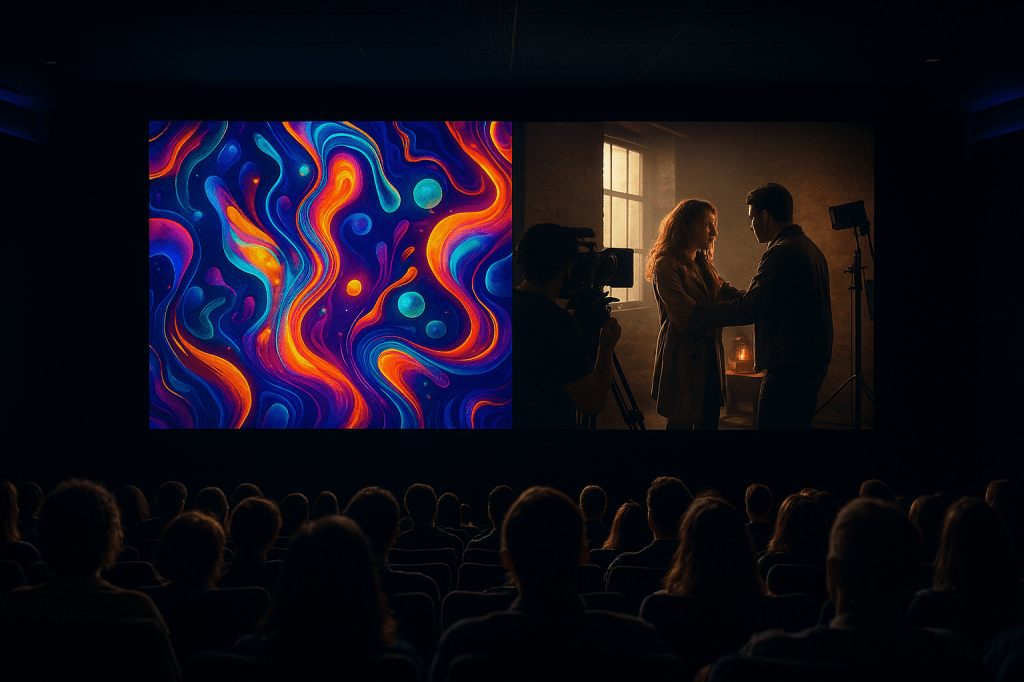
- What it is: The third annual AI Film Festival (AIFF), hosted by Runway in NYC’s Lincoln Center, followed by screenings in Los Angeles and Paris.
- Scale: A massive jump from 300 submissions in 2023 to 6,000 AI-enhanced short films in 2025.
- Purpose: To celebrate and explore content integrating generative AI techniques, from AI-only to hybrid AI/live-action shorts.
Festival Highlights & Winners
- 230 finalists → 10 showcased across three cities.
🏆 Top film: “Total Pixel Space” by Jacob Adler
- A nine-minute visual essay exploring digital image possibilities, awarded the grand prize.
🏅 Runner-up: “Jailbird” by Andrew Salter
- A surreal story of a chicken in a prison rehabilitation program.
🏀 Third Place: “One” by Ricardo Villavicencio & Edward Saatchi
- An interstellar future tale.
- Visit Villavicencio studio web for more info
How AI Was Used
- Films ranged from fully AI-generated to hybrid, mixing live-action with AI-powered visuals.
- Judges evaluated not just aesthetics, but also how effectively AI was integrated and innovated within each entry.
- Winner “Total Pixel Space” is celebrated for its artistic depth and technical mastery.
Industry Momentum
- Runway’s CEO, Cris Valenzuela, emphasizes AI as a tool, not a replacement, democratizing consistent, high-quality creation. The festival included 6,000 submissions and industry collaboration.
- Festival’s growth mirrors rapid advances in generative video tech, with improved clarity and audio fidelity.
Artistic Trends & Challenges
- Films have moved from abstract visuals to more narrative-driven storytelling, embracing both AI aesthetics and plot coherence.
- Remaining limits include scene consistency and logical flow—AI still needs careful prompting and human oversight.
Why It Matters
- Creative access: Independent creators worldwide now use generative AI in film.
- Industry impact: Studios, VFX artists, editors—AI tools shorten production time and costs.
- Future questions: Concerns around copyright, labor, authenticity, and AI’s role in creative hierarchies remain pressing.
Key Takeaways
| Question | Insight |
|---|---|
| What is AI Film Festival? | Runway’s event showcasing AI-integrated short films, with screenings in major cities. |
| How did it grow so fast? | From 300 to 6,000 submissions in two years—reflecting booming interest in generative video tools. |
| What types of films appear? | Fully AI-generated, hybrid AI/live-action stories, experimental narratives. |
| Why do people care? | It pushes creative boundaries and opens the door for more accessible, diverse filmmaking. |
| Any concerns? | Potential downsides include job disruption, copyright risks, and ethical storytelling challenges. |
Looking Ahead
- Wider adoption: AI is integrating further into production pipelines across all levels.
- Creative evolution: Expect richer hybrid formats and more emotionally engaging AI-driven narratives.
- Regulatory focus: As AI-made content grows, rights, compensation, and fair use become critical.
- Industry support: Collaborations with guilds and councils (e.g., American Cinema Editors, SAG-AFTRA) aim to ensure safe, beneficial AI integration.
Final Thoughts
The AI Film Festival 2025 is more than a showcase. It’s proof that generative AI has matured into a powerful tool for creative expression. With explosive growth in participation and artistic innovation, the festival frames AI not as a cinematic replacement, but as a collaborative medium.
However, for AI to boost creativity rather than disrupt livelihoods, the industry must balance innovation with responsibility through clear copyright frameworks, ethical usage, and supportive policies for creatives.
In short: This festival marks the dawn of a new hybrid era, where AI and humans co-author the next generation of storytelling.




 AI Everything Today
Leave a comment