
For years, our primary interaction with artificial intelligence has been conversational. We type a question into a search engine or a chatbot, and it gives us an answer. We ask a voice assistant to play music or set a timer, and it performs that specific, often simple, command. This model, while useful, requires constant human input and direction. We are the drivers, and AI is merely responding to our steering.
But a significant shift is underway. AI is no longer content to just chat or follow explicit instructions. It’s learning to understand our underlying goals, plan the steps needed to achieve them, and even execute those steps with increasing autonomy. This is the rise of the AI agent – systems designed not just to answer questions, but to work for you.
Think of the difference between asking a friend for directions (a simple request, like a chatbot) and asking that friend to plan an entire road trip for you – booking hotels, finding restaurants, managing the itinerary, all based on your preferences (an agent-like task). The latter requires understanding a larger objective, breaking it down into smaller parts, and executing multiple actions without needing approval for every single step.
What Exactly is an AI Agent?
An AI agent, in this context, is a system built on advanced AI (often large language models, but with additional components) that can:
- Understand Complex Goals: They can grasp high-level objectives articulated in natural language, not just simple commands.
- Break Down Tasks: They can decompose a large goal into a sequence of smaller, manageable steps.
- Plan and Execute: They can determine the necessary actions to complete each step and interact with tools, applications, or other systems to perform those actions.
- Reason and Adapt: They can evaluate the results of their actions, handle unexpected issues, and adjust their plan accordingly.
- Maintain Context and Memory: They remember past interactions and progress towards the goal to ensure continuity.
While a traditional chatbot excels at generating text or answering single queries based on its training data, it typically doesn’t do things in the external world or manage complex workflows. You ask a chatbot “How do I book a flight?”, and it gives instructions. An AI agent, however, could potentially go and book the flight for you, coordinating with airline websites, payment systems, and your calendar, perhaps after asking clarifying questions about dates, destinations, and preferences.
The core distinction lies in the proactivity and autonomy. Chatbots wait for your input. Agents, once given a goal, can initiate actions and manage a sequence of operations to pursue that goal without needing you to micromanage every click or command.
From Concept to Reality: Early Examples of AI Agents in Action
The concept of AI agents has been explored in research for years, but recent advancements in AI models have made practical applications closer to reality. We’re starting to see glimpses of this future integrated into everyday tools and platforms.
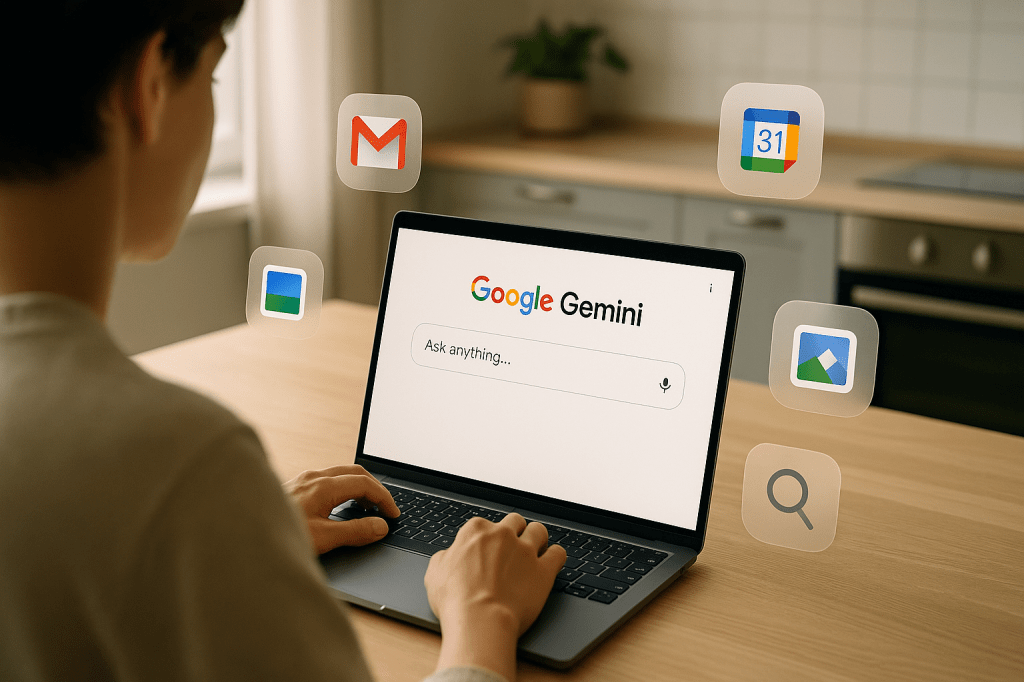
One widely discussed example is the potential for AI to summarize and manage your digital inbox. Google’s Gemini, for instance, has demonstrated capabilities that go beyond simply extracting information. It can analyze lengthy email threads, identify key decisions, action items, and deadlines, and present a concise summary. This moves beyond just retrieving information (like a search) or generating text (like a summary you prompt it to write) to understanding the context of your communication and proactively presenting the most relevant insights without you having to read through everything. Imagine waking up to an inbox already distilled into the most important messages and action items for the day. That’s an agent working for you.
Another area is device and platform integration. While not fully autonomous agents in every sense yet, tools like Perplexity integrating into Samsung devices hint at a future where AI is deeply embedded, capable of performing context-aware tasks. Instead of just answering a question, AI on your device could potentially manage settings, optimize performance, or even interact with apps based on your observed usage patterns and stated preferences, anticipating your needs rather than just responding to prompts. This requires the AI to understand the device’s environment, available tools, and the user’s intent in a much more dynamic way than current assistants.
In the business world, AI productivity is seeing a surge thanks to agent-like capabilities automating internal workflows. Instead of manually transferring data between spreadsheets, drafting routine emails, or generating basic reports, AI agents can be configured to handle these multi-step processes.
- Data Processing: An agent could monitor incoming data feeds, clean and structure the data, perform basic analysis, and update relevant databases or dashboards.
- Customer Support Triage: Agents could analyze incoming customer inquiries, identify the nature of the problem, gather necessary context from CRM systems, and route the query to the appropriate department or even provide initial automated responses for common issues.
- Meeting Management: An AI agent could schedule meetings, send out invitations, share relevant documents beforehand, take notes during the meeting, and distribute summaries and action items afterward, coordinating across multiple calendars and applications.
These examples, while perhaps not fulfilling the full sci-fi vision of a completely autonomous digital assistant, represent the foundational steps towards AI systems that take initiative and manage complex tasks across different digital environments. They highlight the transition from AI as a reactive tool to AI as a proactive partner.
The Benefits: Why AI Agents Matter for Productivity
The primary promise of AI agents is a significant boost in productivity and a reclaiming of our time. In an increasingly complex digital world, we spend hours on repetitive, administrative, or information-gathering tasks that take us away from higher-value work or personal pursuits.
- Time Saving: By automating multi-step processes – whether it’s managing your email, scheduling appointments, researching topics, or handling data entry – agents can free up significant portions of your day. Imagine an agent handling all the logistics of planning a business trip, from booking flights and hotels to scheduling meetings and arranging transport, all while you focus on the content of your trip.
- Increased Efficiency: Agents can operate 24/7 without fatigue, processing information and executing tasks far faster than a human can. They can also handle parallel tasks simultaneously, multiplying the output.
- Focus on High-Value Work: By offloading routine or complex but repeatable tasks to AI agents, humans can concentrate on creative thinking, strategic planning, interpersonal interactions, and problem-solving that requires human judgment and empathy.
- Personalization: As agents learn your preferences, habits, and priorities, they can tailor their actions and assistance specifically to you, becoming true AI assistants that anticipate your needs.
- Accessibility: For individuals with disabilities or those facing digital literacy challenges, agents could potentially simplify complex digital interactions, making technology and online services more accessible by handling the technical steps behind the scenes.
This isn’t just about doing the same tasks faster; it’s about fundamentally changing how we interact with technology and manage our work and lives. It’s about moving towards a future where technology is a proactive collaborator, not just a passive tool awaiting instructions. This future of future of AI work isn’t science fiction; it’s rapidly approaching.
Important Questions and Challenges: Trust, Oversight, and Boundaries
While the potential benefits of AI agents are immense, their increasing autonomy also raises crucial questions and challenges that need careful consideration as this technology develops and is deployed. The shift from AI as a tool you explicitly direct to AI as an agent taking initiative fundamentally changes the human-AI relationship.
- Trust: Can we trust an AI agent to take actions on our behalf, especially actions that have real-world consequences, like sending an email, making a purchase, or modifying a document? Building trust requires transparency in how agents make decisions and clear mechanisms for understanding their capabilities and limitations.
- Oversight and Monitoring: If an agent is performing complex tasks autonomously, how do we monitor its progress and ensure it stays on track and acts correctly? We need effective ways to oversee agent activity without having to verify every single step, which would negate the productivity benefits. Dashboards, summary reports, and alert systems will be crucial.
- Setting Boundaries and Control: How do we define the limits of an agent’s autonomy? What actions require explicit human approval, and which can the agent take on its own? Users need granular control over what their agents can and cannot do, ensuring that the AI works for them, not independently of them. This includes setting financial limits, access permissions, and scopes of action.
- Security and Privacy: AI agents will likely need access to sensitive data (emails, calendars, financial information, internal company data) and various accounts to perform their tasks. Ensuring the security and privacy of this data is paramount. Robust authentication, authorization, and data handling protocols are essential.
- Accountability: If an AI agent makes a mistake – sends an incorrect email, books the wrong flight, deletes important data – who is accountable? The user? The developer? The company deploying the agent? Clear frameworks for understanding responsibility and recourse in the event of AI agent errors are needed.
- Explainability: Understanding why an agent took a particular action can be challenging, especially for complex AI models. For users to trust agents and effectively oversee them, there needs to be a degree of explainability, allowing humans to audit the agent’s decision-making process when necessary.
Addressing these challenges isn’t just a technical problem; it’s a societal and ethical one. As we design and deploy autonomous AI systems, we must build in safeguards, transparency, and user control from the ground up. The goal is not to replace human decision-making entirely, but to augment it, allowing AI agents to handle complexity while humans retain ultimate oversight and control.
Framing AI as a Collaborator
The rise of AI agents signals a shift in how we should think about artificial intelligence. It’s less about using AI as a simple tool, like a calculator or a search bar, and more about engaging with it as a collaborator or a team member.
A good human collaborator doesn’t just wait for explicit instructions; they understand the project’s goals, take initiative, offer suggestions, and manage parts of the workflow independently while keeping you informed. AI agents are moving towards this model. They can be assigned a project (“Plan the annual team retreat,” “Research potential suppliers for X,” “Manage the social media posting schedule”) and work on it, potentially interacting with other systems, gathering information, drafting content, and presenting options or completing steps as appropriate.
This collaborative model requires a different kind of interaction. Instead of a rapid-fire sequence of commands and responses (like chatting), it involves assigning goals, providing context and constraints, checking in on progress, and refining objectives as needed. It’s more like managing a project or delegating tasks to a team member.
The successful integration of AI agents into our lives and work will depend heavily on our ability to design intuitive interfaces for setting goals, monitoring progress, and intervening when necessary. It will also require a cultural shift in how we perceive and interact with AI – moving from skepticism or over-reliance to a nuanced understanding of AI as a powerful, but not infallible, partner.
The Future of AI Agents
The capabilities of AI agents are expected to grow significantly. We could see agents that are:
- More Integrated: Tightly woven into operating systems, browsers, and enterprise software, allowing seamless interaction across different applications.
- More Capable: Able to handle increasingly complex, ambiguous, and novel tasks, requiring less initial direction and intervention.
- More Personalized: Developing a deep understanding of individual users’ needs, preferences, and work styles to provide highly tailored assistance.
- More Collaborative (among themselves): Potentially, multiple AI agents could collaborate on larger projects, each handling a specific aspect and coordinating with others, mirroring human teamwork.
Imagine a world where your personal AI agent manages your schedule, communications, finances, and information flow, while your work AI agent handles project management, data analysis, and collaboration tools. These agents could even interact with each other, coordinating your professional and personal life.
The development of AI agents explained simply requires understanding this evolution from passive tools to proactive partners. It’s a trajectory that promises unprecedented levels of productivity and personalization, fundamentally altering the landscape of work and our daily lives.
Conclusion
The era of AI agents is dawning. Moving beyond the chatbot, these proactive, autonomous systems are poised to take on multi-step tasks, manage complex workflows, and act as true AI assistants that work for you. From summarizing emails and automating routine business processes to potentially managing personal logistics and interacting with devices based on your needs, AI agents have the potential to unlock massive gains in AI productivity.
However, realizing this potential requires navigating significant challenges related to trust, oversight, control, security, and accountability. As this technology matures, open dialogue, thoughtful design, and a focus on human-centric control mechanisms will be essential.
The future of AI work is one where humans and AI agents collaborate, each bringing their unique strengths to the table. AI agents will handle the complexity, repetition, and sheer volume of tasks that overwhelm us today, while humans will provide the creativity, critical thinking, emotional intelligence, and strategic direction that AI still lacks. This partnership holds the key to a more productive, efficient, and potentially more fulfilling future. Get ready to meet your new AI colleague – it’s coming, and it’s ready to get to work.


 AI Everything Today
Leave a comment